
Jefferson County Jail Capacity Overview
The Sheriff's Corrections Division runs two adult jail facilities: the Birmingham County Jail at 809 Richard Arrington Jr. Boulevard North and the Bessemer County Jail at 1822 2nd Avenue North. Together they average a population of 1,000 inmates at a time. The official rated capacity for each facility is not published on the Sheriff's site, so the table below uses the published average and notes the capacity gap.
| Facility | Official Capacity | Average Population |
|---|---|---|
| Birmingham County Jail | Not published by Sheriff | Part of combined 1,000 |
| Bessemer County Jail | Not published by Sheriff | Part of combined 1,000 |
| Combined Jefferson County jails | Not published | Approximately 1,000 |
Average Daily Population
The Sheriff describes the 1,000-inmate figure as the average population across both facilities. That number is not a live roster count. It is a descriptive average that smooths the daily turn-over from bookings and releases. The live count on any given day can sit above or below 1,000 depending on weekend bookings, holiday slow-downs, court schedules, and transfers to ADOC.
To see the live point-in-time count, the Sheriff's Inmate Inquiry can be filtered with In Custody checked and a housing facility selected. The result count is a near-real-time roster for the facility chosen.
Annual Bookings and Flow
The Sheriff's page reports about 43,000 inmates processed in and out of jail each year. That is the flow number. Against a county population the U.S. Census QuickFacts places at 665,742 for 2025, the flow is significant: roughly one booking per fifteen residents per year, though many bookings involve repeat individuals.
Flow and stock measure different things. Average population (1,000) is stock at a point in time. Annual bookings (43,000) is flow over a year. Both matter. A small-stock, high-flow jail like Jefferson County's has many short-stay bookings between sentence transfers, bond releases, and pretrial release decisions.
Corrections Staffing
The Corrections page says 185 deputies are assigned to both jail locations. That number is not the full Sheriff's Office headcount; the Sheriff also runs Court Services, Warrant Detail, civil process, patrol, training, and administrative units. Per-shift staffing on the housing floors is set by classification, security level, and population at the time.
Both facilities have on-site medical services. The Birmingham facility has law libraries and adult educational services on site. The Sheriff's published text does not extend those services to the Bessemer facility.
Pretrial vs. Sentenced Population
The Inmate Inquiry detail page lists a Prisoner Type, such as Pretrial Inmate, on each booking. The Pre-Trial Release Office operates out of both jails to help eligible pretrial inmates secure release and to help the public post bond when pretrial release is not available. The Sheriff's site does not publish a current breakdown of pretrial vs. sentenced inmates, but the Prisoner Type field on the detail page is the source for that split case-by-case.
| Category | Notes |
|---|---|
| Pretrial inmates | Held while case moves through court; often eligible for pretrial release. |
| Sentenced inmates | Serving short sentences or waiting transfer to ADOC. |
| Holds for other agencies | Federal, ICE, or out-of-county warrant holds. |
Misdemeanor and Felony Population
The split between misdemeanor and felony inmates is not posted as a single statistic on the Sheriff's public page, but the case-type pattern follows the court structure. District Court handles misdemeanors and felony preliminary hearings, and Circuit Court handles felonies. A misdemeanor sentence served in Jefferson County stays in county jail; a long felony sentence moves to ADOC after sentencing and intake.
The Sheriff's average of 1,000 inmates therefore mixes pretrial felony defendants waiting for trial, sentenced misdemeanants serving short county time, sentenced felons waiting transfer, and other holds. The roster's Charges Table on each detail page lists the specific counts in each booking.
Medical and Mental Health Services
Both facilities have on-site medical services. Mental-health needs in county jails are a national issue, and the Sheriff does not publish a public mental-health subpopulation count. Probate Court handles civil commitments separately under its mental-health commitment function; those proceedings are restricted records and do not show in the public jail roster.
Note: The public roster does not show medical, suicide watch, or protective custody flags. Any sensitive flag exists only on internal jail management screens.
State and National Jail Population Context
For state and national jail data, the Bureau of Justice Statistics publishes the Annual Survey of Jails and Census of Jails. The Prison Policy Initiative publishes an Alabama profile with state-level incarceration rates and a county-level breakdown for many counties. The Vera Institute Incarceration Trends project covers county-level jail data and is a useful comparison source.
| Geography | Source | What to Compare |
|---|---|---|
| Jefferson County, AL | Sheriff Corrections page | Average population, annual bookings |
| Alabama statewide | BJS, Prison Policy Initiative | Jail rate per 100,000 |
| United States | BJS Annual Survey of Jails | Jail rate per 100,000 |
Note: Specific per-100,000 numbers shift year over year; pull the latest BJS or Vera data for any comparison meant for publication.
Population Trends Over Time
The Sheriff's site does not publish a multi-year trend chart for jail population. The current baseline is two facilities, an average population of 1,000, about 43,000 annual bookings, and 185 deputies assigned to corrections. Year-over-year comparison requires pulling from BJS, the Vera Institute, and county budget documents, all of which are public.
U.S. Census QuickFacts puts the 2020 county population at 674,721 and the 2025 estimate at 665,742. A small population decline with a steady jail average suggests a stable per-capita jail use, but the underlying drivers (charging policy, bond setting, court speed) sit outside any single public dataset.
Where the Data Comes From
Three primary sources cover Jefferson County jail data. The Jefferson County Sheriff's Corrections Division page publishes average population, annual bookings, staffing, and service notes. The Sheriff's Inmate Inquiry portal supports live roster filtering by housing facility. BJS, Prison Policy Initiative, and U.S. Census QuickFacts provide the state and national context.
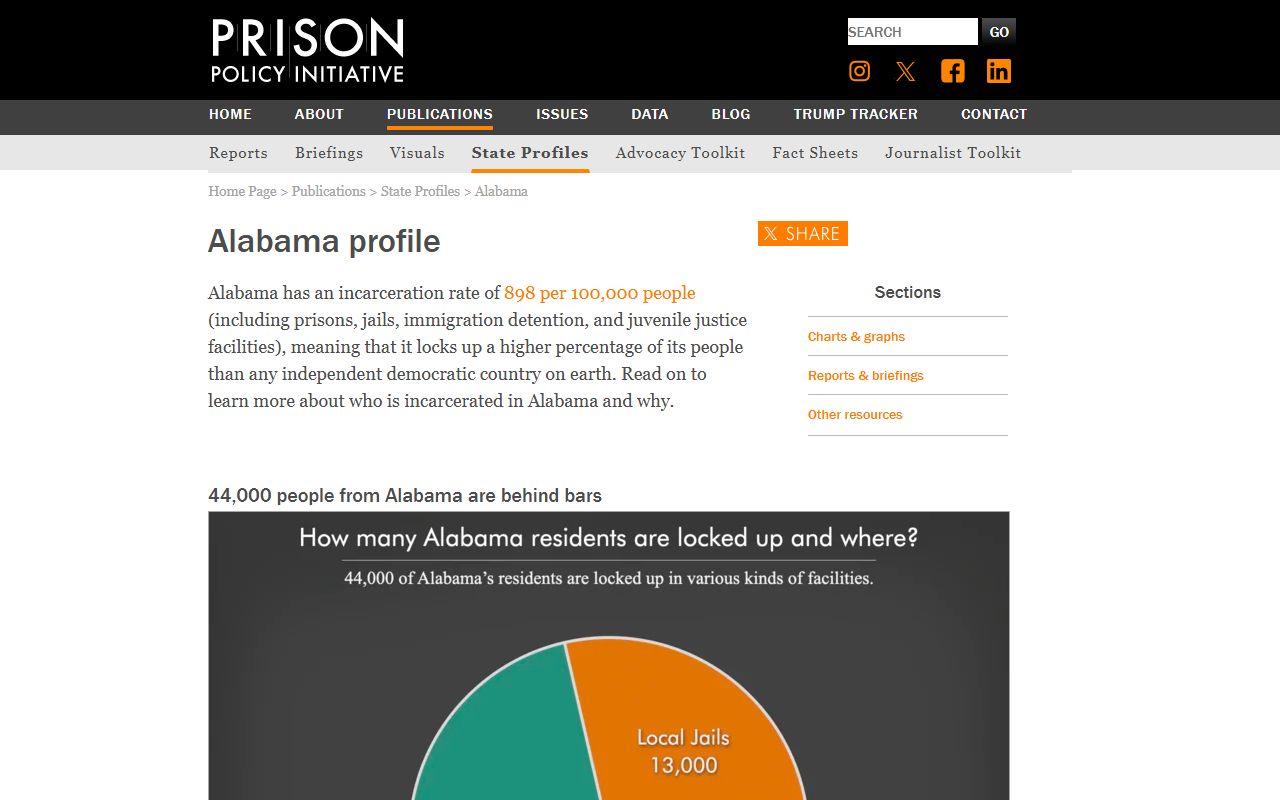
The Prison Policy Initiative Alabama profile gives the state-level baseline used in the comparison table above.
Jefferson County Demographics
Jefferson County demographics shape the population the jail system processes. U.S. Census QuickFacts puts the 2025 population estimate at 665,742, the land area at 1,111.53 square miles, and the median household income at $66,388 for 2020-2024. The county is 52.8% White alone, 43.1% Black alone, 2.0% Asian alone, 1.6% two or more races, and 5.9% Hispanic or Latino. Veterans count 29,334. Persons in poverty stand at 14.2%.
The 1,111-square-mile land area is part of why the county runs separate Birmingham and Bessemer jails. Warrant officers move long distances within the county and across state lines on Jefferson County warrants. Court Services serves about 250,000 civil processes and over 20,000 warrants a year.
Research Gaps in the Public Data
Several pieces of the public-data picture sit behind official-only sources. The Sheriff does not publish a rated capacity per facility, a current pretrial vs. sentenced split, an annual demographic breakdown, or a multi-year jail population chart. Those numbers exist on internal jail management systems and in county budget documents, but they are not on the public Sheriff page.
For a deeper Jefferson County jail data set, the Vera Institute Incarceration Trends project covers many counties with multi-year jail population, admissions, length of stay, and demographic data. County budget documents adopted by the Jefferson County Commission are another source for staffing changes, capital project plans, and policy notes.
Note: Always pull the most current BJS or Vera dataset before using a per-100,000 jail rate for publication; the rates shift year over year and stale numbers misread the trend.
Reading Jail Capacity the Right Way
The word "capacity" gets used loosely in public reporting. A rated capacity is set by the original facility plan and certification. A functional capacity is what the staff can safely manage given the inmate mix and staffing. An emergency surge capacity is the short-term limit. Jefferson County publishes neither rated nor functional capacity on its public corrections page; the published figure is the average daily population of about 1,000 inmates across both jails.
The cleanest public read is the average population the Sheriff has published: about 1,000 inmates spread across Birmingham and Bessemer. That number is recent enough to use without overpromising.